
Reward costs in channel loyalty programs are rising, but not always for the right reasons. In many cases, higher spending is a response to declining engagement rather than a driver of it. Brands increase incentives to maintain participation, but without improving how those incentives work, the returns remain inconsistent.
In India’s channel ecosystems, where dealers, distributors, and retailers often engage with multiple competing brands, this problem becomes more pronounced. Loyalty programs that rely heavily on rewards without understanding partner behavior tend to become expensive and inefficient.
Reducing reward costs, therefore, is not about cutting budgets. It is about improving reward efficiency, channel engagement quality, and behavioral alignment.
Why Reward Costs Keep Increasing in Channel Loyalty Programs
Most reward inflation is a result of poor loyalty program design, not market pressure. When incentives are tied only to transactions, brands are forced to continuously increase reward value to maintain the same level of participation.
This creates a dependency loop. Partners engage when incentives peak and disengage when they normalize. Over time, loyalty programs lose their ability to influence behavior without higher spending.
Another structural issue is lack of segmentation. High-performing partners receive rewards they would have earned anyway, while low-engagement partners remain unaffected. Without differentiation, reward budgets are spread thin across the ecosystem without meaningful impact.
In absence of channel loyalty analytics, most programs operate without clarity on which incentives are actually driving incremental behavior.
Low Channel Engagement Drives Higher Costs
The real cost driver in most loyalty programs is not rewards; it is low channel engagement efficiency. If only a small percentage of partners actively participate, the effective cost per engaged partner increases significantly. Inactive or partially active partners dilute program impact while still contributing to operational and incentive overhead.
This creates a false perception that more rewards are needed, when in reality, the issue lies in activation and participation. Increasing engagement within the existing partner base often delivers better ROI than expanding reward budgets.
Programs that fail to address engagement drop-offs end up compensating with higher incentives instead of fixing the underlying issue.
The Reward Cost vs Engagement Trade-Off: Myth vs Reality
The assumption that higher rewards directly lead to higher engagement is misleading. In practice, reward size has diminishing returns when relevance is low.
Generic incentives, even when high in value, often fail to drive consistent participation. On the other hand, targeted incentives aligned with partner behavior can create stronger engagement at a lower cost.
The trade-off is not between cost and engagement. It is between inefficiency and optimization. When rewards are designed with context, timing, partner profile, and behavior, they become more effective without requiring higher spend.
Key Reasons Loyalty Programs Waste Reward Budgets
Rewarding the Wrong Behavior
Programs that focus only on purchases miss the opportunity to influence upstream behaviors such as product awareness, training, and promotion. This limits long-term impact and reduces engagement depth.
One-Size-Fits-All Incentives
Uniform reward structures ignore variability in partner potential and motivation. Incentives that are too generic fail to resonate, leading to lower participation and wasted spend.
Poor Redemption Experience
When redemption is complex or unclear, perceived value drops. Even strong incentives lose effectiveness if partners cannot easily access or understand their benefits.
Lack of Data Visibility
Without visibility into engagement patterns and reward performance, programs cannot evolve. This results in continued investment in incentives that may not be driving meaningful outcomes.
Over-Incentivizing Active Partners
Top-performing partners often receive disproportionate rewards without incremental behavior change. This inflates costs without improving engagement or loyalty.
Strategies to Reduce Reward Costs Without Losing Engagement
Shift from Transaction-Based to Behavior-Based Rewards
Rewarding behaviors such as training participation, product promotion, and platform engagement creates earlier and more consistent touchpoints. This reduces reliance on high-value transactional incentives.
Personalize Incentives Based on Partner Segments
Segmentation allows incentives to be aligned with partner capability and intent. Targeted rewards improve conversion while reducing unnecessary distribution across low-impact segments.
Optimize Reward Catalogs
Analyzing redemption data helps identify which rewards actually drive engagement. Removing low-performing options and focusing on relevant rewards improves both participation and cost efficiency.
Improve Redemption Simplicity
Ease of redemption directly impacts perceived value. Clear structures and frictionless processes increase utilization without increasing reward value.
Use Non-Monetary Incentives
Recognition, access, and exclusivity create engagement without direct financial cost. These mechanisms are particularly effective in strengthening long-term partner relationships.
Focus on High-Value Partner Segments
Allocating resources based on partner lifetime value ensures that reward budgets are directed toward segments that contribute the most to business outcomes.
Run Micro-Campaigns Instead of Large Schemes
Short, targeted campaigns allow better control over spend and faster feedback loops. This enables continuous optimization rather than periodic over-investment.
The Role of Channel Loyalty Analytics in Cost Optimization
Cost optimization requires visibility into how rewards translate into behavior. Without this, programs remain reactive.
Channel loyalty analytics connects incentive spend with engagement outcomes. It helps identify which actions are being influenced, where participation is dropping, and how different segments respond to rewards.
Platforms like Insights Ai by Almonds Ai enable this by providing real-time visibility into partner activity, reward utilization, and engagement trends. This allows programs to be adjusted continuously, reducing waste and improving efficiency.
Key Metrics to Track for Cost Efficiency
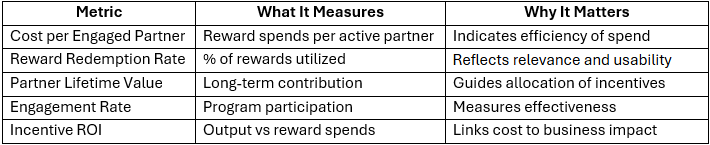
These metrics are most effective when analyzed together rather than in isolation.
How Leading Brands Balance Cost and Engagement
Effective programs do not reduce costs by limiting rewards. They improve efficiency by aligning incentives with behavior and continuously refining program design.
This involves identifying where rewards drive incremental value, eliminating low-impact spend, and adapting strategies based on real engagement data. Over time, this creates a system where cost and engagement move in the same direction rather than opposing each other.
The Future: Smarter, Leaner Loyalty Programs
Channel loyalty programs are moving toward systems that are adaptive, data-driven, and behavior-focused. Static incentive structures are being replaced by dynamic models that respond to partner activity in real time.
Advancements in analytics and AI will further improve precision, enabling programs to deliver higher engagement with lower spend. The focus will shift from reward distribution to engagement optimization.
Conclusion
Reducing reward costs is not a budgeting exercise. It is a design problem. Programs that rely on increasing incentives to maintain engagement will continue to see rising costs without proportional returns.
In contrast, programs that focus on behavior, segmentation, and analytics can improve engagement while reducing spend. The goal is not to spend less. It is to spend with clarity, intent, and measurable impact.
FAQs
How can businesses reduce loyalty program costs without affecting engagement?
Businesses can reduce loyalty program costs by focusing on efficiency rather than cutting rewards. This includes targeting high-value partners, optimizing reward catalogs, and using analytics to track performance. Many b2b loyalty platform providers in Mumbai, Bangalore, and Indore now offer data-driven tools that help brands identify where rewards are being wasted and how to improve engagement without increasing spend.
Do higher rewards always lead to better engagement in channel loyalty programs?
Higher rewards do not always result in better engagement. In many cases, relevance and timing matter more than reward value. Personalized incentives and behavior-based rewards often outperform generic high-value incentives. Leading loyalty program companies in Bangalore and Mumbai focus on engagement design rather than just increasing reward budgets, helping brands achieve better results with optimized spending.
What is the most effective way to optimize reward costs in a loyalty program?
The most effective way to optimize reward costs is to align incentives with partner behavior and performance. This includes segmenting partners, rewarding meaningful actions, and simplifying redemption. Many b2b loyalty platforms in Indore and other emerging markets are increasingly adopting analytics-led approaches to ensure that every reward contributes to measurable engagement and ROI.
How do loyalty analytics platforms help reduce program costs?
Loyalty analytics platforms help reduce costs by providing visibility into partner behavior, reward usage, and engagement trends. They enable businesses to identify low-performing incentives, reduce unnecessary spend, and focus on high-impact activities. Modern loyalty program companies in Mumbai and Bangalore are integrating AI-driven analytics to continuously optimize program performance and cost efficiency.
How should businesses choose the right loyalty program platform in India?
Choosing the right platform depends on business goals, partner ecosystem complexity, and scalability requirements. Businesses should look for platforms that offer analytics, personalization, and flexible reward management. Evaluating b2b loyalty platform providers in Mumbai, Bangalore, or Indore can help identify solutions that are aligned with local market dynamics as well as enterprise-level capabilities.
Are loyalty programs relevant for regional markets like Indore and tier-2 cities?
Yes, loyalty programs are highly relevant in regional and tier-2 markets where channel relationships play a critical role in business growth. In cities like Indore, loyalty programs help brands strengthen distributor and retailer engagement, improve visibility, and drive consistent performance. Many loyalty program companies in Indore are now focusing on localized strategies to support these ecosystems effectively.